
If you’re paying for clicks, you’re already doing the hard part: getting local prospects to raise their hand. Retargeting is how you stop those “almost-customers” from disappearing after one visit.
Most local buyers don’t convert on the first click. They compare options, ask someone, get busy, and search again later. Retargeting (and its close cousin, remarketing) keeps you visible during that decision window—so your next qualified lead often costs less than your first. Google’s own setup is designed specifically for this: you add visitors to audience lists via a Google Ads tag (or equivalent source) and then show tailored ads to those lists across eligible placements.
What is retargeting in PPC, and why does it convert faster than cold traffic?
Retargeting in PPC is the practice of showing ads to people who have already interacted with your business—most commonly by visiting your website—so you can bring them back when they’re ready to take action. In Google Ads, this typically starts with adding a remarketing tag or using an audience source so visitors can be added to lists you can target later. (Google documentation covers standard remarketing setups and tagging approaches.)
It often converts faster than cold traffic because it removes the “who are you?” phase. Cold audiences need education and trust-building before they’ll submit a form or call. Retargeted audiences are already past that first hurdle. They clicked because they had intent. Your job is to help them finish the decision.
For local service businesses, this “warm intent” shows up in the pages and actions people take. Someone reading your pricing page, reviewing testimonials, or reaching the booking screen is already leaning toward contact. Retargeting works best when it’s treated as a continuation of that journey, not as a separate campaign you run “because you should.”
What’s the difference between remarketing and retargeting, and does it matter for local lead generation?
In day-to-day PPC conversations, people use the terms interchangeably. Practically, here’s how to think about it:
- Retargeting usually means ad-based re-engagement using behavioral audiences (site visitors, video viewers, etc.).
- Remarketing often includes first-party lists (like Customer Match/CRM lists) plus broader re-engagement tactics.
Does it matter? It does when you start using first-party data.
For example, Google Ads Customer Match lets you upload customer information (like email/phone) to reach those users across Google properties—but it comes with strict policy requirements around consent and data use.
So for most local lead gen accounts:
- Start with pixel/tag-based audiences (fastest to deploy).
- Add Customer Match later when you’re ready to handle consent, hygiene, and exclusions properly.
Why do most local retargeting campaigns underperform even when the audience is “warm”?
Warm audiences don’t magically fix broken fundamentals. Most underperforming retargeting campaigns fail for a few predictable reasons:
The offer doesn’t match the moment
Someone who visited your “Pricing” page needs reassurance (proof, clarity, ease), not a generic “Learn More.”
The audience is too broad
“All site visitors (30 days)” sounds safe, but it mixes:
- tire kickers
- job seekers
- existing customers
- accidental clicks
with your highest-intent prospects.
The ads don’t earn attention
If your creative looks like every other local ad, people tune it out fast—especially with repeated exposure.
You’re annoying them without realizing it
Ad fatigue is real. Frequency capping exists for a reason: on supported campaign types, Google Ads lets you cap impressions per person (or let Google optimize frequency), so you don’t burn budget and goodwill showing the same message endlessly.
The measurement is misleading
If you only track “leads” (not qualified leads, booked calls, closed deals), you’ll optimize toward volume—not outcomes. Offline conversion import and enhanced conversions for leads exist specifically to connect ad interactions to offline outcomes like calls and sales.
How do you build a retargeting funnel that fits a local buyer journey (not an ecommerce checkout)?
A local buyer journey is usually: need → research → compare → contact → book → show up → pay.
A retargeting funnel that matches that looks like this:
1) Start with the “ready now” segment
These are people who hit your money pages:
- service pages
- pricing/financing pages
- booking/contact pages
- “about” + reviews/testimonials (high intent combo)
Goal: get the call/form submission with proof-first messaging.
2) Add a “form-start / booking-start” rescue layer
If someone started a form or reached a booking page but didn’t submit, they’re not a branding problem. They’re a friction problem.
Goal: remove friction (clear steps, time estimate, what happens next, fast response).
3) Build a “research mode” layer
Blog readers and general visitors may need more time.
Goal: guide them to the strongest proof assets:
- review highlights
- before/after (when relevant)
- case results
- “what it costs” transparency
- “how it works” explainer
4) Use Search retargeting for the “search again later” moment
Remarketing audiences applied to Search campaigns (“your data segments”) allow you to adjust bids or messaging when previous visitors search again.
This is a big deal for local PPC because many leads convert on a second or third search—often with slightly different keywords (“near me,” “open now,” “reviews,” “cost”).
What audiences should you create first for the highest ROI?
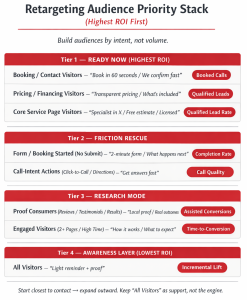
The fastest ROI comes from building audiences based on intent, not volume. Think in terms of “how close were they to contacting us?” rather than “how many people can we retarget?”
Begin with high-intent page visitors: the people who visited core service pages, pricing pages, and booking/contact pages. These visitors have already indicated they’re actively evaluating and are often one strong reassurance away from converting. This audience usually delivers the quickest lift because you’re following up with the right people at the right time.
Next, focus on action-adjacent behaviors: visitors who reached your booking flow, started a form, clicked to call, or engaged with key conversion elements. If you can track these events cleanly, they’re among the highest quality retargeting pools you can build.
After that, expand into proof consumers and engaged users—people who read reviews/testimonials, spent meaningful time on the site, or visited multiple pages. This group can convert well, but it typically needs more trust-building and a slightly longer time horizon.
Only then should you broaden into general visitors. For many local businesses, “all visitors” is useful mainly as a low-budget awareness/support layer, not as the engine of retargeting performance.
This structure aligns with the way strong PPC frameworks recommend list segmentation: you win by prioritizing behavioral intent and building purposeful lists rather than throwing everyone into one pool.
How do you choose between pixel-based retargeting, list-based retargeting, and RLSA?
Most accounts should start with pixel- or tag-based audiences because they are the most direct reflection of current intent. Someone who just visited your pricing page is actively evaluating. Tag-based retargeting lets you respond to that immediate behavior with messaging that fits.
List-based retargeting, like Customer Match, becomes valuable when your business has repeat services, upsells, reactivation cycles, or a long follow-up process. It’s also useful for exclusions—one of the most overlooked “wins” is simply stopping ads from chasing existing customers or already-booked leads. Because list-based approaches have additional privacy and policy responsibilities, they work best when your tracking and data processes are mature.
Search retargeting (often referred to as RLSA or “your data segments” used with Search) is a different tool for a different moment. It isn’t a reminder; it’s an advantage in an auction. When people search again, they’re closer to action. Recognizing that they’ve already visited you gives you a reason to bid differently or tailor ad copy and landing experiences. For many local lead gen accounts, that “second search” is where a meaningful share of conversions actually happens.
What ads and offers work best for retargeting when you sell services (not products)?
Service retargeting wins when your ads reduce perceived risk and increase confidence.
Proof-first angles (highest impact for local)
- “Hundreds of local 5-star reviews” (if true)
- “Before/after results” (when appropriate)
- “Licensed/insured/certified” (where relevant)
- “Same-week appointments” (only if operationally real)
Risk reducers
- “Free estimate” / “free consultation”
- “Upfront pricing ranges” (even a “starts at” + what affects price)
- “No-pressure assessment”
- “Fast response time” (with a real SLA)
Stage-based message examples
- Service page visitor: “Still comparing? See pricing + what’s included.”
- Booking page visitor: “Book in 60 seconds—pick a time, we confirm fast.”
- Research visitor: “See the 3 things to check before hiring a contractor.”
One extra rule that local businesses miss: your landing page should match the retargeting promise. If the ad says “same-week availability,” the page should say what that means and how booking works.
How do you set budgets, frequency caps, and exclusions so you don’t waste money?
Budgeting (simple, practical approach)
Retargeting budgets should be sized to your audience volume. If your retargeting list is small, you can’t “force” spend efficiently without over-frequency.
A good starting principle:
- fund retargeting enough to maintain presence
- avoid bidding so high that you repeatedly hit the same people all day
Frequency capping (protects performance and brand)
Google Ads allows frequency capping on supported campaign types, and it can work differently by campaign type. Google also notes that third-party cookies are used by default for frequency capping and first-party cookies may be used when third-party cookies aren’t available.
Exclusions (where the wasted spend hides)
At minimum, exclude:
- converters (leads/customers) for a defined window
- employees and internal traffic
- irrelevant geographies (outside your service radius)
- low-intent pages (careers, generic blog traffic) from your “hot” audiences
If you’re doing PPC management Indianapolis campaigns for lead gen, exclusions are often the difference between “retargeting works” and “retargeting is expensive awareness.”
How do you measure retargeting success beyond CTR and feel-good attribution?
CTR is not the goal in retargeting. Getting more clicks from people who already know you can be a trap if those clicks don’t become qualified leads.
The right primary metric for local PPC is almost always tied to outcomes: cost per qualified lead, booked rate, cost per booked appointment, and—when you can track it—cost per closed deal. Retargeting should improve these by increasing the share of “right-fit” leads and by shortening the path to contact.
If your sales process happens offline (calls, estimates, in-person consultations), connecting PPC to real outcomes is crucial. Google supports offline conversion imports and enhanced conversions for leads to help advertisers measure what happens after a click when the final sale occurs outside the website. When you import qualified outcomes back into the ad platform, optimization becomes smarter. Instead of bidding to generate any form fill, you can train the system to find the kinds of leads that actually book and pay.
Measurement discipline is also how you avoid over-crediting retargeting. If everything looks like a retargeting win because it “touched” the user, you’ll over-invest in the wrong layer. A healthier approach is to compare performance by audience intent tier, watch time-to-conversion, and—where possible—test incrementality through controlled changes.
When should a business hire PPC management Indianapolis support instead of DIY retargeting?
DIY can work when you have:
- clean tracking already installed
- a simple offer and short sales cycle
- time to build audiences, ads, and reporting
You should consider professional PPC management Indianapolis support when:
- your leads convert offline and you need better attribution
- you want segmented retargeting (not one generic list)
- you need creative testing and landing page improvements
- you’re tired of paying for leads that don’t book
A quick “hire help” checklist:
- Are you tracking calls + forms reliably?
- Do you know which campaigns produce booked appointments?
- Are you excluding converters and low-quality traffic?
- Are you running different ads for different audience intent levels?
If you answered “no” to two or more, your retargeting likely has easy wins sitting on the table.
FAQ
Is retargeting “creepy,” and how can you do it without annoying potential customers?
It can feel creepy when frequency is too high or messaging is too personal. Keep it respectful: cap frequency where possible, rotate creative, and focus on helpful proof and clarity rather than “we saw you do X.” Frequency capping exists specifically to manage repetitive exposure.
Can retargeting work for low-traffic local sites, or do you need thousands of visitors?
It can work on low traffic, but you must be selective. Build “high-intent” audiences (service/pricing/booking pages) and use Search retargeting (RLSA / your data segments) so you’re targeting people at the moment they’re searching again.
How long should your retargeting window be for service businesses?
A practical approach is to match the typical decision window. Urgent services might need shorter windows; high-consideration services can use longer ones. The best answer is empirical: test membership durations and look at time-to-conversion in your data.
What’s better for local businesses: Google Display, YouTube, or paid social retargeting?
Use the channel that fits intent:
- Search retargeting for “search again later” conversions
- YouTube/Display for reminder + proof in the consideration phase
The strongest performance often comes from pairing Search with one supportive channel, rather than spreading thin across all.
Does retargeting still work with privacy changes and cookie restrictions?
Yes, but implementation and measurement matter more. Google’s documentation notes how frequency capping relies on cookies and may approximate impressions using first-party cookies when third-party cookies aren’t available—so you should expect some variability and focus on conversion-quality measurement where possible.
Conclusion
Retargeting is the fastest way to increase conversions because it targets people who already showed intent—your “almost customers.” The key is to stop treating it like generic awareness and start treating it like a structured follow-up system: prioritize high-intent audiences, match the offer to the moment, control frequency, and measure success using qualified outcomes (booked calls, sales), not just clicks.
When you pair smart audience segmentation with offline measurement, retargeting becomes one of the most efficient layers in a local PPC account—especially when competition and CPCs keep rising.
Why QBall Digital is Your Ideal Choice for Retargeting and Remarketing?
QBall Digital approaches retargeting like a conversion system, not a checkbox. That means building intent-based audience tiers (pricing/booking visitors, form starters, proof consumers), writing ads that actually match where the prospect is in the decision, and setting exclusions so you don’t waste spend on people who already converted—or never had a chance of converting in the first place.
Just as importantly, QBall Digital focuses on measurement that reflects real business outcomes. If your leads close offline, we’ll help connect the dots with tracking and conversion imports so your campaigns optimize toward booked work and revenue—not “pretty” on-platform metrics. The result is retargeting that feels intentional to your customer and profitable to your business.
Get a Retargeting Conversion Plan from QBall Digital
If you want retargeting that drives more booked calls and fewer junk leads, QBall Digital can map out a conversion plan built around your actual buyer journey.
Get your Retargeting Conversion Plan from QBall Digital and you’ll walk away with:
- a prioritized audience stack (what to build first)
- a recommended ad sequence + offer angles
- exclusions and frequency guidance
- measurement recommendations aligned to lead quality