
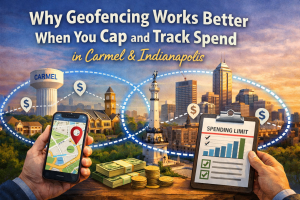
If you’re running targeted display advertising in Carmel & Indianapolis, you’re dealing with two different realities that just happen to share a metro map. Indianapolis can deliver a lot of impressions quickly (sometimes too quickly). Carmel often requires tighter planning to get quality reach without over-layering your targeting into under-delivery.
The good news: you can run a two-market geofencing strategy that stays efficient—if you treat it like performance media, not a “draw a circle and hope” tactic.
What does “targeted display advertising Carmel & Indianapolis” actually mean in practice?
It means using display ads (often programmatic) with targeting layers that ensure your impressions go to the right people—specifically within Carmel and Indianapolis—without paying for waste.
Targeted display can include:
- Geotargeting (cities, ZIPs, radiuses)
- Geofencing (hyper-specific polygons around places)
- Audience layers (in-market/interest, first-party lists, etc.)
- Contextual layers (content themes/keywords)
- Inventory controls (allowlists, exclusions, viewability thresholds)
Geofencing matters because it lets you target place-based intent—people who visited a competitor, a category hub, or an event venue. But it’s not a full strategy on its own. Without rules for who qualifies, how long they qualify, how often they see ads, and where ads appear, geofencing can still burn a budget.
Why do Carmel and Indianapolis behave like different geofencing markets?
Because the audience profile and delivery environment are different enough to change your economics—especially your CPM, pacing, and lead quality mix.
A few baseline indicators show why “same metro” isn’t “same campaign”:
- Carmel’s median household income is dramatically higher than Indianapolis’s (Census QuickFacts).
- Carmel’s educational attainment (bachelor’s degree or higher) is also substantially higher (Census QuickFacts).
What that usually changes in practice:
- Offer sensitivity: Carmel audiences may respond better to trust, outcomes, convenience, and premium positioning, while Indy can be more responsive to clear value and reduced friction (industry pattern—not a rule).
- Inventory and pacing: Indianapolis often has broader inventory supply (more impressions available), which can cause fast spend if you don’t throttle delivery.
- Fence selection: Carmel tends to reward intentful nodes (specific destinations) while Indy can support clusters (denser commercial areas), as long as you manage drive-by traffic and exclusions.
When should you split Carmel and Indianapolis into separate campaigns instead of one?
Split them when you care about budget control, messaging precision, or clean performance learning. Combine only when you must.
Split into separate campaigns when:
- You have different CPL targets or different lead-quality standards by market
- Your creative/offer differs (or should differ)
- You need different pacing (common: Indy overspends early while Carmel under-delivers)
- You need market-level reporting you can act on quickly
Keep them together only when:
- Your budget is very limited and you need conversion volume to learn
- Your offer, landing page, and success metrics are truly identical
- You can still enforce strict geo segmentation at the ad group/line-item level
Best-practice structure for budget safety:
- Carmel – Prospecting (fences + light overlays)
- Carmel – Retargeting (site visitors / engaged users / CRM where applicable)
- Indianapolis – Prospecting
- Indianapolis – Retargeting
This structure prevents Indianapolis delivery volume from “stealing” spend from Carmel and makes your optimization decisions obvious.
What are the top ways geofencing burns budget in a Carmel vs Indianapolis setup?
Most waste comes from “eligible impressions” that aren’t buyer intent—plus runaway frequency and poor inventory.
Here are the usual culprits:
1) Indianapolis cannibalizes spend through sheer delivery volume
If Indy is easier/cheaper to deliver, your platform will happily spend there unless you hard-limit budgets or split campaigns.
2) Drive-by traffic gets counted as “targeted”
Large radiuses around busy roads, shopping centers, or mixed-use corridors can pull in people who never actually engaged with the location.
3) You don’t exclude employees, residents, or repeat passersby
If you fence your own location (or a competitor) without exclusions, you’ll repeatedly pay to show ads to:
- employees,
- neighbors,
- routine commuters,
- delivery drivers.
4) No recency rules
If someone visited a place once, three months ago, should they still be eligible today? Usually not. Recency is a massive budget lever.
5) No frequency cap
Frequency capping is one of the simplest, most direct ways to prevent display waste. Google Ads supports frequency capping for Display campaigns.
6) Low-quality inventory drains spend
If you don’t control placements, you can end up paying for impressions that are technically served but rarely seen. Viewability standards exist for a reason: an impression is generally considered “viewable” when ≥50% of pixels are in view for ≥1 continuous second for display.
How do you choose fences that signal intent instead of “people who happened to be nearby”?
Fence places that predict purchase behavior—not just places with foot traffic.
Use fence types that map to buyer intent:
High-intent fence categories
- Competitor locations (conquesting): Great when you have a clear differentiator and a landing page built to convert “comparison” traffic.
- Category hubs: Where your buyers shop around (auto rows, medical clusters, fitness corridors, home improvement areas).
- Event venues: Short-window intent spikes (home shows, tournaments, conventions).
- Your own locations: Often better for exclusions + retargeting, not prospecting.
A simple prioritization method
Score each fence idea on:
- Intent strength (does this location correlate with buyers?)
- Audience volume (enough devices to learn without forcing frequency?)
- Sales-cycle fit (will a visit here matter next week or next quarter?)
Visual suggestion (1 of 2): A one-page “Fence Menu” graphic showing fence types, recommended radiuses, and default exclusions for suburban nodes (Carmel) vs urban clusters (Indianapolis).
How should you set radius, dwell time, and recency windows to keep targeting tight?
Start with rules that reduce false positives, then widen only if you’re under-delivering.
Radius: go smaller than you think
- Tight radiuses reduce drive-by traffic but can shrink audience too far in Carmel.
- In Indianapolis, smaller fences + multiple locations often outperform one giant fence.
Dwell time: filter accidental presence
If your platform allows it, use dwell-time logic to reduce “passed through” devices.
Recency: treat it like a dial, not a checkbox
Your recency window should match your buying cycle:
- High urgency (restaurants, urgent services): short recency windows
- Considered purchases (home services, elective medical, higher-ticket retail): medium windows
- Long cycle (B2B, higher-ticket commitments): longer windows, but still capped and sequenced
Even without perfect precision, recency discipline tends to reduce wasted spend and improve lead quality.
What targeting layers should you add (and what should you avoid) to protect budget?
Add layers that cut waste without strangling delivery—especially in Carmel.
Layers that usually help
- First-party audiences (site visitors, engaged sessions, CRM lists where applicable)
- Contextual targeting (content themes relevant to your offer)
- Light audience overlays (only if they don’t collapse reach)
Layers to be careful with
- Stacking too many overlays on Carmel prospecting can lead to under-delivery and higher CPMs without improving outcomes.
- Overly narrow “interest” targeting combined with small fences can produce tiny audiences that you then over-frequency (waste again).
Don’t ignore geo intent settings (Google Ads)
Google Ads location options can include people in or regularly in a location, and/or people who have shown interest in it; these advanced location options affect who you actually reach.
If you’re running geo-based campaigns and your results look “off,” this setting is one of the first places to audit.
How do you control frequency and creative fatigue when your audience is hyper-local?
You control it by capping exposure, sequencing your message, and tracking frequency distribution—not just average frequency.
Google Ads supports frequency capping in Display campaigns so you can limit how many times ads appear to the same person.
Practical rules that tend to prevent waste:
- Prospecting: lower frequency caps (avoid annoying the same small pool)
- Retargeting: higher caps than prospecting, but still controlled
- Sequencing: rotate creative by exposure count (e.g., proof → offer → urgency)
The key is to avoid paying for the 12th impression to the same person when the first 5 already told you they weren’t going to click.
What creative and CTA approach works best for Carmel compared to Indianapolis?
The best creative matches the “why” behind the location visit and removes friction.
Carmel creative usually wins with:
- trust signals (reviews, guarantees, credentials)
- premium reassurance (“done right,” “white-glove,” “expert-led”)
- convenience and time-saving
- appointment-forward CTAs (book now / schedule consult)
Indianapolis creative often wins with:
- clarity and speed (what you do, who it’s for, what happens next)
- strong offer/value framing when appropriate
- “reduce friction” CTAs (get quote, check availability, same-week options)
Message-to-moment examples
- Competitor fence: “Considering [category]? See why locals switch—get a fast quote in 60 seconds.”
- Event fence: “At the show? Get a show-only bonus + priority scheduling this week.”
- Category hub: “Compare options in one place—transparent pricing + no-pressure consult.”
Landing pages matter here: if the ad promises something specific, the page must deliver that exact next step.
How should you allocate and pace budget so Indianapolis doesn’t cannibalize Carmel?
Separate budgets or enforce hard caps, then reallocate weekly based on CPL and lead quality.
A practical starting approach:
- Allocate a base split based on your business priority (quality vs volume).
- Reserve 10–20% for controlled testing (creative, fences, overlays).
- Put pacing controls in place so Indy can’t burn through the entire daily budget early.
If you keep both markets inside one campaign, Indianapolis can quietly dominate delivery simply because it’s easier to spend there—especially if your targeting is broad.
Which KPIs prove the strategy is working (not just spending)?
You need three layers of truth: delivery quality, performance, and business outcomes.
Delivery quality KPIs
- Viewability (are ads actually seen?)
The MRC/IAB viewability guideline commonly used for display is 50% of pixels in view for 1 continuous second. - Placement quality (are you on credible sites/apps?)
- Frequency distribution (how many people are over-exposed?)
Performance KPIs
- CTR (in context—don’t worship it)
- CVR (landing page conversion rate)
- CPL / CPA
Business outcome KPIs
- Qualified lead rate
- Booked appointments / sales accepted leads
- Store visits (only if measurement is reliable for your setup)
Visual suggestion (2 of 2): A “Carmel vs Indianapolis Budget Safety Scorecard” showing reach, frequency distribution, viewability, CPL, and qualified rate—side-by-side each week.
What does a lean 30-day testing plan look like for two-market geofencing?
It looks like controlled learning with stop-loss rules—not endless “tweaking.”
Week 1: Baseline + safety rails
- Split markets or enforce strict market caps
- Set frequency cap
- Apply placement/inventory exclusions
- Launch with a small set of high-intent fences
Week 2: Fence refinement
- Remove low-performing fences
- Tighten radiuses where drive-by traffic is suspected
- Add exclusions (employees/residents/commuters where possible)
Week 3: Creative iteration
- Replace fatigue creative
- Test one new offer angle per market (not five at once)
Week 4: Scale winners + cut losers
- Shift budget toward fences producing qualified leads
- Expand with “lookalike” fence sets (similar venues/competitors)
Stop-loss examples:
- Spend thresholds without qualified outcomes
- Suspicious placements
- Runaway frequency in small audiences
FAQ
How small should a geofence be around a competitor or venue to avoid drive-by traffic?
Small enough that you’re capturing actual visitors, not pass-through traffic—then expand only if you under-deliver. If you can use dwell time, use it to filter accidental presence.
Can I retarget people after they leave a geofenced location, and how long should that window be?
Yes—most setups allow a “visit → eligibility window.” Match it to your sales cycle and cap frequency so you don’t overpay for stale intent.
Should Carmel and Indianapolis share the same audience overlays and exclusions?
Not automatically. Carmel often needs lighter overlays to maintain reach; Indianapolis often needs stricter pacing and placement controls to prevent overspend.
What’s the difference between geofencing and geotargeting?
Geotargeting is broader location selection (city/ZIP/radius). Geofencing is a tighter boundary around a specific place designed to capture place-based intent.
What frequency cap prevents waste when the audience is small?
A conservative cap for prospecting is typically safer; increase only if performance improves. Google Ads frequency capping is designed specifically to limit repeated exposure.
How do I keep low-quality apps and placements from draining budget?
Use placement controls, exclusions, and supply transparency tools. Standards like ads.txt/app-ads.txt exist to reduce inventory fraud by allowing publishers/apps to declare authorized sellers.
How long does it take to know if a Carmel vs Indy split is working?
Often you’ll see delivery and efficiency differences quickly, but judge success on qualified outcomes—not just CTR or CPM. A 30-day structured test usually yields clearer answers than a “forever test.”
Conclusion
A budget-safe geofencing strategy comes down to discipline:
- Treat Carmel and Indianapolis as two different performance environments.
- Fence intentful places, not just busy places.
- Control recency + frequency so you don’t pay for repeated exposure to the same small pool.
- Audit location settings and inventory quality so the right people see your ads—and actually see them.
If you build the strategy around guardrails first, scaling becomes easy—and defensible.
Why QBall Digital is Your Ideal Choice for Two-Market Geofencing?
QBall Digital approaches geofencing like performance advertising, not a novelty tactic. We start with the real question—where does intent actually show up in Carmel vs Indianapolis?—then build a fence plan that’s designed to capture high-quality opportunity while filtering out drive-by traffic and repeat non-buyers.
We also prioritize budget control and clean learning. That means separating markets when it matters, setting frequency and recency rules that prevent waste, and tightening inventory so you’re not paying for impressions that never had a real chance to influence a decision. The result is a program that’s easier to optimize, easier to report, and far more likely to produce qualified leads—not just spend.
Start a Budget-Safe Carmel + Indianapolis Geofencing Plan with QBall Digital
Get a Two-Market Fence Map + Exclusion Plan from QBall Digital
If you want a clear, performance-first plan (fences, exclusions, frequency/recency, and pacing), QBall Digital will map it and show you exactly where the budget is likely to leak—and how to fix it.