
When I talk to business owners and marketing managers around Carmel and Indianapolis, the first question usually isn’t “Should we run display ads?” It’s: “Is display going to waste money we could put into search?”
That’s a fair fear—because search feels safe. Someone types in a need, you show up, you pay for the click, and (hopefully) you get the lead.
But here’s the part many PPC teams only learn after they hit a plateau: search ads can become a ceiling. When you’re already bidding competitively, expanding keywords starts lowering lead quality, and your best traffic is mostly branded… you’re not “bad at search.” You’re just boxed into demand capture.
Targeted display is often the unlock because it does something search can’t do well on its own:
It reaches the right people before they search—and it helps you influence what they search for (and who they call).
Below is a step-by-step framework (modeled after the “Step 1, Step 2…” structure from the Medium guide you shared) that will help you decide when targeted display advertising actually beats search ads in Carmel & Indianapolis—and how to prove it with numbers.
Step 1: What is targeted display advertising, and how is it different from search ads?
Targeted display advertising shows image, native, or video ads across websites, apps, and inventory in networks like the Google Display Network, using targeting signals (audiences, content, placements, location, etc.) to reach specific people.
Search ads are different: they appear when someone actively searches a keyword, making them intent-capture by nature.
Here’s the simplest way to separate them:
- Search = “I need this now.”
- Display = “This is for people like you… and here’s why you should care.”
Display targeting can be built around audience signals and/or content signals (topics, placements, contextual keywords, exclusions), and Google’s “content targeting” options are managed together in a streamlined way inside Google Ads.
So why do people get disappointed by display?
Because they expect it to behave like search (high intent, last-click conversions) even though it’s designed to influence demand earlier and assist conversion paths.
Step 2: Why does targeted display advertising matter specifically for Carmel & Indianapolis campaigns?
Carmel and Indianapolis aren’t “small markets,” but they do have a reality every local advertiser runs into:
- People don’t live on Google Search all day.
- Most buying journeys start before the keyword.
- Many decisions are shaped by repetition, familiarity, timing, and trust—not only the cheapest CPC.
Targeted display matters locally because it can reach:
- people in the right geography (geo/proximity),
- people in relevant contexts (contextual),
- people who already visited your site (retargeting),
- and people who match your ideal customer profile (audience segments/first-party).
In other words: display helps you win attention before the “near me” moment.
Step 3: When does targeted display beat search ads in practice?
Targeted display tends to beat search when your goal isn’t just “show up when they search”—it’s increase the number of qualified people who decide to search and convert.
Here are the clearest scenarios where display can outperform search on incremental outcomes:
- When your category is CPC-expensive or hyper-competitive
If your search CPCs are climbing and expanding keywords lowers lead quality, display can give you cheaper reach and help you shape demand so that when people do search, they search for you or convert faster. - When you need demand creation (new offer, new location, new service line)
Search can’t capture demand that doesn’t exist yet. Display can introduce and educate the right audience, at scale. - When your funnel is longer than one click
For considered purchases (home improvement, elective care, B2B services), people often need multiple exposures before converting. - When you already have traffic—but you’re losing the second chance
Retargeting is often one of the highest ROI display use cases because it reconnects with people who already showed intent by visiting your site.
Google specifically calls out evaluating display performance by considering conversions beyond clicks (including view-through in appropriate contexts), which reflects the reality of how display contributes in multi-touch journeys.
Step 4: What are the clearest signs your Carmel/Indy search ads are capped and display is the unlock?
Search plateaus happen in predictable ways. Here are the “tell me this is you without telling me this is you” signals:
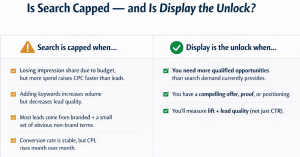
You’re capped when…
- You’re consistently losing impression share due to budget, but raising budget increases CPC faster than leads.
- Adding keywords increases volume but decreases lead quality.
- You’re mostly capturing branded demand and a small set of obvious non-brand terms.
- Your conversion rate is stable, but your cost per lead rises month over month.
Display is the unlock when…
- You want more total qualified opportunities than search demand currently provides.
- You can offer something compelling enough to earn attention (offer, proof, positioning).
- You’re willing to measure outcomes like incremental conversions, assisted paths, and lead quality—not just CTR.
Step 5: How do you choose the right targeting approach for Carmel & Indianapolis?
This is where most display campaigns either become a profit lever… or a money leak.
Rule: pick targeting based on funnel stage, not preference.
Top-of-funnel (introduce + qualify)
Contextual targeting (topics, placements, display keywords) helps you align ads with relevant content environments. Google describes keyword contextual targeting as matching ads to content and notes it can suit advertisers focused on performance and cost-efficient conversions when built around strong themes.
Mid-funnel (nurture + compare)
Use audience segments and creative angles that answer:
- “Why this option?”
- “Why this provider?”
- “What’s the proof?”
Bottom-funnel (convert)
Retargeting + strong offer + friction-reducing landing pages.
A simple “don’t mess this up” checklist
- Use exclusions (irrelevant placements, poor-quality apps/sites, competitor employees if possible).
- Don’t stack five targeting layers so tightly that you strangle delivery.
- Decide your frequency philosophy early (more on that below).
Step 6: How should you structure a “display vs search” budget in a local PPC mix?
There’s no universal split—but there is a smart way to start.
Budget model A: Capture-first (when leads must be immediate)
- Search: 70–85%
- Display: 15–30% (mostly retargeting + tight contextual)
Budget model B: Balanced growth (when you want scale without sacrificing efficiency)
- Search: 55–70%
- Display: 30–45%
Budget model C: Expansion mode (when search is capped and you want more market share)
- Search: 40–60%
- Display: 40–60% (with structured creative testing + measurement discipline)
The practical move: start with a pilot display budget you can defend for 30–45 days, designed to answer one question:
“Did display create incremental qualified leads we wouldn’t have gotten from search alone?”
Step 7: What creatives actually work for targeted display in local markets?
If targeting is your steering wheel, creative is your engine.
The display ads that work in Carmel & Indy usually share three traits:
1) One message, one action
Not five features. Not a paragraph. One clear promise with one next step.
2) Proof beats polish
Logos, short testimonials, review counts, awards, or “as seen in” style trust markers often outperform “pretty but vague.”
3) Local relevance without awkward geo-stuffing
Instead of repeating “Carmel” and “Indianapolis” in every line, use natural cues:
- “Northside appointments available”
- “Serving Hamilton County and the Indy metro”
- “Fast scheduling this week”
Creative angles to test (3–5 is enough):
- Problem → outcome (“Stop overpaying for… / Get…”)
- Offer-driven (“Free estimate / Same-week consult”)
- Proof-driven (“4.8★ average / 200+ five-star reviews”)
- Differentiator (“No contracts / Transparent pricing”)
- Risk reversal (“No-obligation / Cancel anytime”)
Step 8: How do you measure whether display is outperforming search (or just generating cheap clicks)?
If you measure display like search, you’ll undercount its value or optimize toward the wrong thing.
The cleanest measurement hierarchy
- Primary conversions (forms, calls, purchases)
- Lead quality signals (qualified, booked, revenue)
- Assists (where display contributes to a path that later converts)
- Engagement (only when it correlates with outcomes)
View-through conversifons: useful, but handle with care
Google defines view-through conversions as conversions where someone saw (but didn’t click) a display/video ad before converting.
That can be valuable for understanding influence—but it should not replace your core evaluation of:
- incremental lift,
- lead quality,
- and blended cost per acquisition.
A practical way to “prove it”
Run a controlled test:
- Separate retargeting vs prospecting campaigns
- Track conversions + quality
- Compare against a baseline (prior 30 days) or use geo splits / audience splits where possible
- Watch for branded search lift and improved conversion rates on search landing pages (often a sign display is warming demand)
Step 9: What are the advantages and risks of targeted display advertising for PPC-focused teams?
Advantages
- Scale: reach buyers before they search
- Flexibility: audience + contextual options
- Assisted impact: supports multi-touch paths
Risks (and how to avoid them)
- Waste from broad targeting → tighten themes, exclusions, and creatives
- Ad fatigue → manage frequency (next step)
- False confidence from CTR → optimize to qualified outcomes, not clicks
Step 10: How do you launch a targeted display campaign for Carmel & Indianapolis step-by-step?
This is the launch sequence we use when the goal is performance and proof—not vanity impressions.
1) Define the conversion you actually care about
Not “traffic.” Not “engagement.”
A real business outcome (lead, call, booked consult, purchase).
2) Choose your targeting lane
- Retargeting (bottom-funnel)
- Contextual prospecting (mid-to-top)
- Audience/first-party expansion (when you have data)
Google outlines that Display campaigns can use targeting signals to find audience segments that help meet your goals.
3) Build exclusions and brand safety rules
Start with what you don’t want:
- irrelevant app categories,
- poor-quality placements,
- sensitive content categories where appropriate.
4) Set frequency strategy early (so you don’t annoy the market)
Google Ads supports frequency capping to manage how often ads show to an individual user over a day/week/month for Display campaigns.
A solid starting point for many local campaigns:
- Prospecting: moderate frequency (enough to build memory, not enough to irritate)
- Retargeting: slightly higher frequency with shorter membership durations, then rotate creative
5) Launch with testing structure (don’t mix everything)
Split by:
- Prospecting vs retargeting
- Creative angle A vs B vs C
- One main targeting method per ad group when possible
6) Optimize weekly (in this order)
- Cut waste (placements/audiences)
- Improve creative and message match
- Tune bids/budget to winners
- Improve landing page conversion rate
Google’s own optimization guidance for Display emphasizes measuring the full value of display (including view-through conversions when evaluating performance) and testing creative assets frequently.
FAQ
Is targeted display advertising worth it for service businesses near Carmel?
Yes—especially when search is expensive or capped and you have a clear offer and strong proof. Display often works best as a demand expander + retargeting closer rather than a pure cold-lead machine.
Can targeted display generate leads, or is it only for awareness?
It can generate leads, but the highest-confidence path is usually:
- prospecting display to warm audiences, plus
- retargeting display to close, plus
- search to capture high intent at the moment it spikes.
How long does it take for display to “work” compared to search?
Search can convert immediately; display often needs more exposures. That’s why a 30–45 day test window (with weekly optimization) is a common, practical approach—especially for local services with non-instant decisions.
What’s a good frequency cap for local campaigns?
There’s no single perfect number, but frequency caps exist for a reason: to manage how often individuals see your ads. Google Ads allows either optimization or manual caps for Display campaigns.
The right cap depends on your category, creative rotation, and audience size.
Does geo/proximity targeting still work with privacy changes?
It can, but the strongest long-term performance usually comes from combining multiple signals (context + first-party + retargeting) and focusing on measurement that reflects real outcomes rather than only cookie-based attribution.
What’s the best way to combine display retargeting with Google Search?
Use retargeting to keep your brand “top of mind” and reduce drop-off after site visits, while search captures the final intent when it spikes. The combination often improves overall conversion efficiency because users return warmer and more decisive.
Conclusion
If search ads are your “harpoon,” display is your “net.”
Search captures demand when it’s explicit. But in Carmel and Indianapolis—where attention is fragmented and competition is real—targeted display advertising can beat search when you need to create demand, expand reach beyond keyword volume, or turn more “almost buyers” into buyers through repetition and trust.
The key is not running display because it’s available—it’s running it with:
- the right targeting lane,
- the right creative angles,
- frequency discipline,
- and measurement that proves incremental impact.
Why Qball Digital is Your Ideal Choice for Targeted Display Advertising in Carmel & Indianapolis?
Qball Digital builds targeted display campaigns like performance campaigns—not like “awareness spend” that’s impossible to defend. We start by identifying where search is capped, where lead quality is slipping, and where your funnel is leaking—then we design display to do one job: create incremental qualified opportunities that your search campaigns alone aren’t producing.
What makes the difference is the system: structured targeting (prospecting vs retargeting), disciplined creative testing (angles that match real buyer psychology), and measurement that connects spend to outcomes you can take to the bank. Instead of optimizing to clicks and hoping for the best, Qball Digital optimizes to what matters—qualified leads, booked work, and revenue—while protecting your brand with smart exclusions and frequency strategy.
Get a Targeted Display Plan from Qball Digital
Start Your Carmel & Indianapolis Display vs. Search Pilot with Qball Digital
If you want to know whether display will actually outperform search for your business (or simply make search work better), request a Display vs. Search Opportunity Plan from Qball Digital. We’ll outline the best-fit targeting approach, a pilot budget you can defend, creative angles to test, and the KPI framework needed to prove ROI—fast.