
If you’re running ads locally, the difference between “busy” and “booked” usually isn’t your budget—it’s your keyword decisions. The right terms pull in people who are ready to call, fill out a form, or request a quote. The wrong terms attract browsers, DIYers, job-seekers, and curious clicks that never turn into revenue.
This guide is a practical system you can use whether you manage campaigns in-house or hire Google Ads management Indianapolis support. The goal: build keyword targeting that consistently produces qualified leads.
What makes a keyword “lead-generating” for Indianapolis searchers?
A keyword generates leads when it aligns with a decision that’s already in motion. The person searching isn’t trying to learn what the service is—they’re trying to pick a provider. That difference shows up in the language they use. Searches that include provider signals (“company,” “agency,” “service”), action signals (“quote,” “estimate,” “schedule”), or urgency (“same day,” “emergency”) tend to produce far more inquiries than broad, generic terms.
The Indianapolis part matters too, but not in the way most people assume. You don’t need to force “Indianapolis” into every keyword if your location targeting is set correctly. Often, strong “hire intent” language does more for lead quality than adding a city name to a vague phrase.
How do Indianapolis customers actually search when they’re ready to hire?
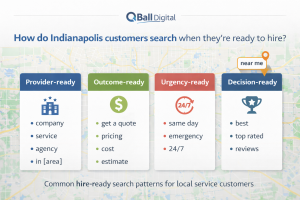
When people are ready to take action, their searches tend to fall into a handful of patterns:
- Provider-ready: “company,” “service,” “agency,” “near me,” “in [area]”
- Outcome-ready: “get a quote,” “pricing,” “cost,” “estimate”
- Urgency-ready: “same day,” “emergency,” “24/7”
- Decision-ready: “best,” “top rated,” “reviews”
The key is to map these patterns to your real conversion path. If you answer calls quickly and close fast, urgency terms can be gold. If your sales cycle is longer, “pricing/quote” terms might outperform “best” terms.
What’s the difference between keywords and search terms—and why does it matter for lead quality?
Keywords are what you choose to target. Search terms are what people actually typed when your ad showed. Those aren’t always the same—and that gap is where wasted spend happens.
Google’s matching options can show your ads on searches that are “close enough” to your keyword (depending on match type), so you need a routine for checking the Search terms report and using it to refine targeting. Google explicitly recommends using the search terms report to find irrelevant queries and turn them into negative keywords.
Which keyword intents convert best for local services (and which ones waste budget)?
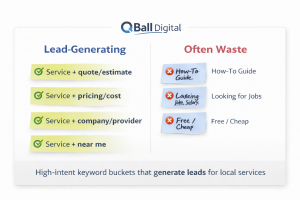
The fastest way to improve lead quality is to sort your keyword list into intent buckets:
Intent buckets that usually produce leads
- Service + “quote/estimate”
- Service + “pricing/cost”
- Service + “company/provider”
- Service + “repair/install” (or the action verb that matches your offer)
- Service + “near me” (when your location targeting is set correctly)
Intent buckets that often waste spend (unless you build guardrails)
- DIY / learning: “how to,” “what is,” “tutorial”
- Career intent: “jobs,” “salary,” “training,” “certification”
- Bargain intent: “free,” “cheap” (sometimes fine, sometimes poison—depends on positioning)
You don’t have to avoid these forever. You just don’t want them mixed into the same campaign as your high-intent terms, where they blur performance and inflate cost per lead.
Why “good volume” keywords often produce bad leads
A lot of high-volume keywords sit at the top of the funnel. They attract people who want information, not a provider. That doesn’t mean they’re useless; it means they’re dangerous when mixed into the same campaigns as your lead drivers.
If your goal is leads, you want keywords that include some form of decision-making language—pricing, quotes, booking, local provider signals, or a specific service problem. When you focus on those terms, you may see fewer impressions, but you’ll usually see a much higher share of searches that convert.
How do you build an Indianapolis keyword list that’s designed for leads first?
Here’s a repeatable build process that works for most local businesses:
1) Start with your “money services,” not your full menu
Pick the 5–15 services that drive the most revenue or the best margins. If a service can’t profitably support a lead cost, it doesn’t deserve early keyword budget.
2) Use Keyword Planner to expand ideas (then refine)
Google’s Keyword Planner is designed to help you discover related terms and see estimates for search volume and cost.
Pull keyword ideas for each core service and export them into a working sheet.
3) Group by theme so your ads can match tightly
Theme-based grouping makes it easier to write specific ads, route clicks to the right landing page, and judge performance cleanly. This is where “lead-first” accounts separate from “traffic-first” accounts.
4) Add conversion qualifiers on purpose
Qualifiers like “quote,” “pricing,” “estimate,” “company,” “service,” and “near me” tend to align with action.
5) Handle geography with targeting settings first, keywords second
You can (and often should) use location targeting to control where ads show rather than stuffing location into every keyword. Google Ads location targeting supports city/area targeting, radius targeting, and location groups.
Which match types should you use for lead gen—and when should you tighten or loosen them?
Google Ads match types influence how closely a user’s query must align with your keyword before you can enter the auction.
A practical approach for lead gen:
- Start controlled with tighter match types on your highest-value services so you can learn what converts without paying for lots of irrelevant variations.
- Expand carefully once you have conversion data, using the search terms report to keep relevance high.
The more you broaden reach, the more important your negative keyword process becomes.
What negative keywords should every Indianapolis lead-gen campaign add early?
Negative keywords block your ads from appearing on searches you don’t want, helping you focus on the searches that matter and improve ROI.
A starter framework most local advertisers should consider:
- Jobs/careers: jobs, hiring, salary, career, internship
- Learning/DIY: how to, tutorial, training, class, course
- Free intent (if you don’t offer it): free, cheap, coupon
- Irrelevant audiences: wholesale, used, parts (industry-dependent)
Then make it systematic: review the Search terms report weekly at first and add negatives whenever you see repeated irrelevant themes. Google specifically calls out the search terms report as a way to find negative keyword ideas.
How should you structure campaigns and ad groups so your keywords turn into leads?
A lead-focused structure is built around clarity:
- Campaigns organized by major service category (or by distinct business line)
- Ad groups organized by one tight theme (one intent cluster)
- Landing pages aligned with the theme (not a generic homepage)
When your ad copy and landing page mirror the query’s intent, you typically see higher conversion rates and fewer wasted clicks because you’re filtering people before they contact you.
How do you write ads and landing pages that match keywords well enough to convert?
Your keyword earns attention. Your page earns trust.
A high-converting local landing page usually includes:
- A headline that matches the searcher’s intent (quote, pricing, service, urgency)
- Proof (reviews, photos, credentials, guarantees)
- Clear service area coverage (without repeating it awkwardly)
- One primary CTA (call or form) with friction removed (short form, click-to-call)
If you’re offering something compelling—like free website design and hosting with SEO services—make sure that offer is tightly connected to the searcher’s intent. Lead quality improves when the offer feels like the logical next step for the query.
Which metrics tell you your keywords are working—and which ones can mislead you?
CTR can go up while leads go down. That’s why lead-gen accounts should be judged primarily on conversion metrics and lead quality—not just engagement.
Cost per conversion and conversion rate show whether a keyword theme is producing inquiries efficiently. Lead quality comes from call recordings, form details, or simple sales feedback: did these turn into real customers? If you can’t connect conversions to real business outcomes, the account will keep optimizing toward the easiest clicks, not the best leads.
When should you pause (or fix) a keyword that isn’t producing leads?
Before pausing a keyword, run a “fix checklist”:
- Are the search terms relevant? If not, add negatives.
- Is the match type too loose? Tighten it.
- Is the ad/landing page mismatched? Align the promise to the query.
- Is the intent wrong for lead gen? Move it into a separate test campaign or exclude it.
Pause after you’ve confirmed it’s consistently spending without producing qualified conversions—and you’ve removed the obvious structural causes.
Is hiring Google Ads management in Indianapolis worth it if you already “have keywords”?
Often, yes—because “having keywords” isn’t the hard part. The hard part is controlling what those keywords turn into once real searches begin coming in.
The ongoing work that usually drives profitability is:
- Match type strategy and guardrails
- Search terms analysis + negative keyword discipline
- Structure, landing page alignment, and conversion tracking
If you’re not doing those things consistently, the keyword list is just a starting point—not a system.
FAQ
How many keywords should I start with for a local Indianapolis campaign?
Start with enough to cover your core services and top intent patterns, but not so many that you can’t monitor search terms weekly. Early on, focus on tight themes you can actively optimize.
Should I include “Indianapolis” in every keyword?
Not necessarily. Location targeting can do a lot of the heavy lifting, and Google Ads supports city/radius targeting options. Use location terms selectively when they reflect how people actually search—or when it improves clarity for a specific theme.
What’s the fastest way to find negative keywords?
Use the Search terms report. It shows the actual queries that triggered your ads and is specifically recommended for finding negative keyword ideas.
Do broad match keywords work for lead gen in 2026?
They can, but only with strong guardrails: clear conversion tracking, frequent search term reviews, and a well-maintained negative keyword list. Match type selection determines how closely queries need to align with your keyword.
Why do I get clicks but no calls or forms?
Usually one of three issues: (1) search terms aren’t truly hire-intent, (2) the landing page doesn’t match the intent, or (3) your offer/CTA isn’t compelling or frictionless enough.
Conclusion
Lead-generating keywords aren’t magic—they’re managed. Start with high-intent themes, use Keyword Planner to expand intelligently, choose match types that fit your risk tolerance, and keep your campaigns clean with consistent negative keyword work. Then measure keywords by what matters: qualified conversions at a cost your business can sustain.
If you want a predictable pipeline, treat keyword selection as a living system—fed by search term data, guided by intent, and refined week after week.
Why QBall Digital is Your Ideal Choice for Google Ads Management Indianapolis?
Most local campaigns don’t fail because the business “picked bad keywords.” They fail because the account never develops a process for controlling match behavior, filtering irrelevant searches, and aligning ads and landing pages to the intent that drives calls and form fills. QBall Digital approaches keyword strategy as a lead-quality engine—built to attract people who are ready to take action, not just research.
What makes QBall Digital especially practical for growth is the way paid traffic and the website experience work together. With free website design and hosting with SEO services, you can launch or rebuild landing pages that match your highest-intent keywords without getting stuck in a long dev queue. That means faster testing, better conversion rates, and a clearer path from click → lead → customer.
Get a Lead-Driven Keyword Plan from QBall Digital
Ready to turn ad spend into consistent inquiries? Ask QBall Digital for a lead-driven keyword plan that includes:
- A prioritized keyword set built around hire-intent
- A starter negative keyword framework
- Recommendations for landing pages that match what searchers actually want