

If you’ve ever felt like Google Ads can burn cash faster than it earns revenue, you’re not imagining it. PPC can “spark an explosion of sales or burn through your ad budget with little return”—and the difference is disciplined PPC management, especially in how the campaign is built.
This guide walks through a campaign-build framework designed to prevent wasted spend at the account-architecture level—before optimization even begins.
What does “PPC management Indianapolis” actually mean in 2026—and what parts most agencies skip?
PPC management is the practice of monitoring, managing, and scaling pay-per-click campaigns—with the goal of improving ROI, not just “getting clicks.”
In practice, PPC management usually includes:
- Goal setting + conversion measurement
- Keyword/audience research
- Campaign structure + launch
- Ongoing optimization + reporting
What many agencies skip (or gloss over) is the part that prevents waste: a documented campaign build that creates guardrails—so you’re not paying for:
- the wrong searches,
- the wrong geographies,
- the wrong traffic sources,
- or “conversions” that don’t represent real leads.
Where does wasted PPC spend come from before the first click even happens?
Most wasted spend is baked into settings and structure, not bidding tricks.
The usual culprits:
- Loose intent grouping: mixing “research” searches with “buy now” searches in the same campaign.
- Tracking that lies: counting low-value actions as primary conversions, or missing key lead actions entirely.
- Geo leakage: serving ads to people outside your actual service area (or to people only “interested in” the location).
- Network leakage: allowing placements that don’t match your goal (e.g., broad reach without controls).
- Post-click mismatch: landing pages that don’t match the keyword intent, so qualified clicks bounce.
The fix isn’t “optimize harder.” It’s build smarter.
How do you set PPC goals that protect budget (instead of vanity metrics that inflate it)?
Set one primary goal that maps to revenue—and treat everything else as supporting signals.
A simple, protective hierarchy:
- Primary conversion: the action that most reliably becomes revenue (e.g., booked consult, qualified lead form, phone call of X seconds).
- Secondary conversions: softer signals (e.g., PDF download, pricing-page view, chat started) that help optimization, but don’t “declare victory.”
Why this matters: PPC platforms will aggressively optimize toward whatever you label as a conversion—so if the goal is fluffy, your spend will follow.
How do you build conversion tracking that doesn’t lie to you?
Accurate conversion tracking is the foundation of profitable PPC management, because it tells you what to scale and what to kill.
At minimum, you want clean website conversion measurement for the actions that matter. Google’s own guidance emphasizes setting up web conversions to measure the actions users take after interacting with ads.
Build it like this:
- Track your real lead events (form submits, phone calls, bookings) as conversions—not just page views.
- Separate lead quality signals from “engagement signals.”
- Keep a tight conversion set early so algorithms learn from the right outcomes.
If you have a sales team, the next level is feeding quality back into the ad platform (e.g., qualified leads, demos booked, closed-won). PPC.co highlights that training optimization on quality, not volume, is what reduces wasted spend—especially in complex B2B journeys.
What’s the safest Google Ads account structure for controlling spend fast?
The safest structure is the one that limits blast radius. That means: when something goes wrong, it can’t burn your whole budget.
A practical structure for most service businesses:
- Separate campaigns by intent (high-intent vs research) and sometimes by service line
- Keep ad groups tightly themed
- Use distinct budgets per intent tier
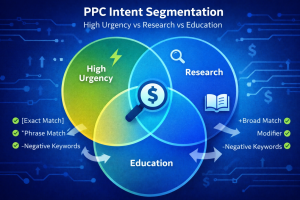
PPC.co’s intent segmentation model (educational vs research vs high urgency) is a strong blueprint—even outside cybersecurity—because it forces you to align keywords, ads, and landing pages to where the buyer actually is.
How do you do keyword research that prioritizes buyer intent in Indianapolis—not just search volume?
You’re not buying keywords—you’re buying intent.
Build your keyword list by:
- Starting with your highest-margin services
- Listing the “I need this now” phrases (emergency/near-me/service + cost + provider)
- Separating research queries into their own bucket so they can’t cannibalize urgent budgets
This is how you avoid paying for curiosity when you need paying customers.
How should match types be used to prevent irrelevant queries from draining budget?
Match types are your reach control knobs. Google explains that match types dictate how closely a keyword needs to match a user’s search query to enter the auction.
A waste-resistant approach:
- Use exact/phrase for core, high-intent terms when you need precision.
- Use broad only when you have strong guardrails (conversion quality, negatives, and query review cadence).
- Split “exploration” (broader reach) from “exploitation” (proven winners) into different campaigns so testing can’t sink performance.
How do negative keywords and exclusions get built like a system (not a one-time task)?
Negative keywords prevent you from paying for searches you don’t want. Google notes that negative keywords let you exclude search terms and focus on what matters to your customers.
Build negatives in two layers:
- Pre-launch negatives (baseline protection): jobs, careers, free, DIY, definitions, cheap/free tools, unrelated adjacent services.
- Ongoing query mining (weekly early on): add negatives whenever irrelevant patterns show up.
Google provides the mechanics for adding negatives at account/campaign levels—do it deliberately and keep it organized.
What geo-targeting settings stop you from paying for clicks outside your service area?
Geo settings can quietly create massive waste.
Google Ads’ “advanced location options” (presence vs presence/interest) can materially change who sees your ads, and Google notes situations where broader targeting can increase conversions—meaning you should choose based on your business model, not defaults.
For most local service-area businesses, a common best practice is:
- Start with tighter “presence” targeting when out-of-area leads are useless.
- Expand only when you can verify lead quality.
Also: align geo intent with your landing page (neighborhoods served, response times, service boundaries). That’s how you pre-qualify clicks.
How do you write ads that “pre-qualify” clicks so you pay for fewer—but better—visitors?
The job of your ad isn’t just to attract clicks—it’s to repel bad clicks.
Use pre-qualification signals like:
- Service boundaries (“Serving the north side + Hamilton County”)
- Timeframes (“Same-week installs available” / “24/7 response” if true)
- Proof (“Licensed/insured,” “industry certifications,” “reviews,” “case results”)
PPC.co’s guidance on credibility-first messaging (technical clarity, proof, and buyer-language) is especially relevant when the buyer is skeptical—because vague claims can increase clicks while decreasing real leads.
How do landing pages prevent wasted spend when ads are doing their job?
Landing pages prevent waste by converting the right clicks and filtering the wrong ones.
A protective landing page does three things:
- Matches the exact intent of the keyword/ad
- Makes the next step obvious on mobile
- Adds friction where needed to reduce junk leads (e.g., “business email,” service-area confirmation, problem type)
PPC.co puts it bluntly: if your ad is about a specific service, the landing page should lead with that exact intent—not a generic homepage.
How do you choose budgets and bidding strategies without letting the algorithm “learn” on your dime?
Choose bidding based on data maturity, not hype.
Practical rule:
- If conversion tracking and lead quality signals are still being validated, start with tighter controls.
- As conversion data becomes reliable, you can test automated strategies more safely.
And remember: PPC management is supposed to maximize ROI—LYFE defines PPC management services as managing strategy and spend with the aim of increasing ROI.
What launch checklist catches the expensive mistakes before they go live?
A pre-launch QA checklist is one of the highest-ROI steps in PPC management.
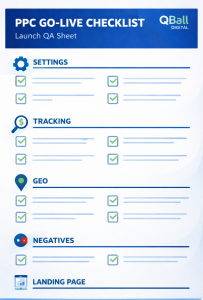
Minimum go-live checks:
- Conversions fire correctly (and only once)
- Location targeting is correct for your service area
- Match types align to intent tiers
- Negative keyword baseline is applied
- Landing page message match is tight
- Budgets are capped per campaign (blast radius control)
When should you scale—and how do you scale without reintroducing waste?
Scale when you have stable lead quality, not just lower CPC.
Scale levers that don’t invite chaos:
- Expand into new intent clusters (in separate campaigns)
- Duplicate winning structure to adjacent services
- Increase budgets gradually on proven campaigns
Avoid scaling by simply loosening targeting. That’s how waste comes back.
FAQ
Is PPC management worth it for smaller Indianapolis businesses with limited budgets?
Yes—if the campaign build is designed to prevent waste. With small budgets, structure and tracking matter even more because you can’t afford “learning by burning.”
How long does it take to see results after a new campaign build?
PPC can produce results faster than SEO, but meaningful performance usually stabilizes after an initial learning period.
Can you run PPC successfully without rebuilding an existing Google Ads account?
Sometimes—but if the account’s structure, tracking, or geo settings are fundamentally wrong, optimization becomes expensive guesswork. A rebuild is often the cheaper path.
What’s a reasonable management fee for PPC in Indianapolis?
It varies by scope and spend, but many agencies price via flat fee or percentage of spend models.
How do I know if my PPC agency is wasting spend?
Look for: unclear conversion definitions, generic landing pages, mixed-intent campaigns, weak negative keyword systems, geo leakage, and reporting that celebrates clicks instead of qualified leads.
Why QBall Digital is Your Ideal Choice for PPC management Indianapolis?
QBall Digital approaches PPC management like an engineering problem: define the outcome, instrument the measurement, then build guardrails before scaling. Instead of treating “optimization” as the magic trick, we treat the campaign build as the profit lever—because it determines what you pay for, what you exclude, and what the algorithm learns.
If you’ve been burned by irrelevant search terms, out-of-area leads, or “conversions” that don’t become customers, QBall Digital focuses on fixing the root cause: intent segmentation, tracking integrity, and waste-resistant structure. The result is a campaign that’s easier to scale because it’s designed to protect your budget from day one.
Get a Waste-Proof Campaign Build From QBall Digital
If you want to see where spend is leaking (and how to fix it), book a PPC teardown with QBall Digital. You’ll get:
- A structure + intent map (what should be separated and why)
- A tracking and conversion QA checklist
- A negative keyword + geo guardrail plan to reduce wasted spend