
 If you’ve been searching Google Ads cost in Indianapolis, you’ve probably run into national “average CPC” numbers that don’t tell you what to budget locally—or ranges so wide they’re useless. In 2026, the real cost comes down to a simple chain:
Clicks → conversion rate → cost per lead → booked revenue.
This guide translates the most cited cost benchmarks (including your two competitor sources) into realistic monthly budget tiers by industry for Indianapolis-area campaigns.
What does “Google Ads cost in Indianapolis” actually include (and what gets left out)?
When people talk about Google Ads cost, they often mean “what I pay Google per click.” But your true monthly cost is usually:
- Ad spend (paid to Google): Your actual media spend.
- Management fees (paid to an agency/freelancer): Strategy, buildout, optimization, reporting, testing. Competitor cost guides commonly reference flat monthly fees and/or % of spend models.
- Landing pages + tracking costs: Call tracking, form tracking, analytics/tag setup, landing page software, CRO improvements.
What gets left out most often: the cost of turning the click into a lead. That’s why two companies can pay similar CPCs but have completely different CPLs.
How does Google Ads decide what you pay per click in 2026?
Google Ads pricing is auction-based. Your CPC depends on your bid (or Smart Bidding’s decisions), your ad/landing page quality signals, and competition.
Google’s own docs emphasize the difference between bids and your average daily budget—your budget acts as a spending control, while bids affect how competitive you are in auctions.
A key point most “cost” articles miss: low CPC doesn’t guarantee low CPL. If your landing page converts poorly or your traffic is the wrong intent, the lead becomes expensive even if the click looks cheap.
What’s different about running Google Ads around Indianapolis compared to national averages?
Indianapolis campaigns tend to win (or lose) on local execution, not national averages:
- Geo settings can quietly waste budget. If you’re not careful, you can show ads to people who express interest in Indianapolis (not physically in your service area), which can inflate CPL.
- Metro targeting changes lead quality. City-only vs. radius vs. suburb clustering (Carmel, Fishers, Greenwood, etc.) can shift performance even with the same keywords.
- Local competition varies by niche. In certain verticals (legal, some medical specialties, high-ticket home services), CPC can behave more like major metros than like “mid-market averages.” Broader benchmark sources consistently show legal/insurance among the most expensive categories overall.
What is a realistic starter budget for Google Ads in Indianapolis if you want results (not “data collection”)?
A starter budget needs to buy enough qualified clicks to produce enough conversions for optimization. Competitor-style pricing guides often cite “small business budgets” that can start low, but low budgets typically slow learning and consistency.
Practical Indianapolis starter ranges (ad spend only):
- Lean testing: $1,000–$2,500/mo
- Competitive starter: $2,500–$6,000/mo
- Aggressive growth: $6,000–$15,000+/mo
If you’re in high-CPC verticals (like legal), “starter” often needs to be higher to generate enough click and conversion volume to make good decisions.
How much should you budget for Google Ads in Indianapolis by industry in 2026?
Below are realistic monthly ad spend ranges (paid to Google), organized as Lean / Competitive / Aggressive tiers. These tiers are designed around how campaigns actually stabilize: enough conversions to optimize, not just enough spend to “try it.”
Where the numbers come from:
- Competitor cost guides commonly cite broad CPC ranges (e.g., pennies to $10+ depending on category) and note that spend varies widely by business and goals.
- Benchmark datasets provide industry patterns for CPC/CPL and confirm year-over-year cost pressure in search ads.
Home Services (HVAC, Plumbing, Roofing, Electrical)
- Lean: $2,000–$4,000/mo
- Competitive: $4,000–$8,000/mo
- Aggressive: $8,000–$15,000+/mo
Best for: consistent weekly lead flow with tight service-area targeting and strong call handling.
Legal (PI, Criminal, Family Law)
- Lean: $5,000–$10,000/mo
- Competitive: $10,000–$25,000/mo
- Aggressive: $25,000–$75,000+/mo
Why: consistently among the highest CPC categories in major benchmark reporting, so you need budget simply to generate enough clicks to learn.
Medical & Dental
- Lean: $2,500–$5,000/mo
- Competitive: $5,000–$12,000/mo
- Aggressive: $12,000–$25,000+/mo
Best for: practices with clear offers (new patient specials, high-intent procedures) and strong scheduling workflows.
Real Estate & Property Management
- Lean: $1,500–$3,500/mo
- Competitive: $3,500–$8,000/mo
- Aggressive: $8,000–$20,000+/mo
Note: qualification steps matter heavily (tenant vs. owner intent, buy vs. rent, etc.).
Automotive (Repair, Body Shop, Dealership Service)
- Lean: $1,500–$3,500/mo
- Competitive: $3,500–$7,500/mo
- Aggressive: $7,500–$15,000+/mo
Best for: repeatable services with high call intent and strong local trust signals.
Ecommerce & Retail
- Lean: $1,000–$3,000/mo
- Competitive: $3,000–$10,000/mo
- Aggressive: $10,000–$50,000+/mo
Reality: CPC can be lower than service verticals, but profitability hinges on margin and conversion rate.
SaaS / B2B Services
- Lean: $2,000–$5,000/mo
- Competitive: $5,000–$15,000/mo
- Aggressive: $15,000–$50,000+/mo
Best for: companies that track qualified lead stages and can feed conversion signals back into optimization.
Education / Training Programs
- Lean: $1,500–$4,000/mo
- Competitive: $4,000–$10,000/mo
- Aggressive: $10,000–$25,000+/mo
Tip: admissions follow-up speed can make or break CPL.
Hospitality / Events
- Lean: $1,000–$2,500/mo
- Competitive: $2,500–$6,000/mo
- Aggressive: $6,000–$15,000+/mo
Tip: budget pacing and scheduling prevent weekend spikes from eating the month.
Visual idea (strategic): A single “Budget Tiers by Industry” table with columns for Lean / Competitive / Aggressive and a short “Best for” note.
How do you calculate the budget you need based on leads (not guesses)?
Use this framework:
- Monthly lead goal (example: 30 leads/month)
- Close rate (example: 30% → ~9 new customers)
- Gross profit per customer (example: $2,000)
- Acceptable acquisition spend (example: 20% of gross profit = $400 CPA)
- Target CPL = CPA × close rate = $400 × 0.30 = $120 CPL
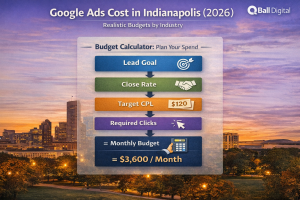
- Monthly budget = leads × CPL = 30 × $120 = $3,600/mo
Then you pressure-test CPL against real-world CPC and your conversion rate. Industry benchmarks exist for CVR/CPL, but your landing page and offer decide whether you beat or lag those averages.
Visual idea (strategic): A simple “Budget Calculator” flow: Lead goal → Close rate → Target CPL → Conv. rate → Required clicks → Spend.
What monthly management fee is normal in 2026, and when is it worth paying?
Competitor cost guides commonly describe several pricing models:
- Flat monthly retainers
- % of ad spend
- Hourly or hybrid structures
It’s most worth paying when:
- Your CPC is high enough that mistakes are expensive (legal/insurance-like competition dynamics).
- You need accurate tracking (calls + forms + quality signals).
- You want ongoing testing that improves conversion rate over time (which is how CPL usually drops without chasing cheaper clicks).
When should you spend more on Google Ads, and when should you fix the funnel first?
Spend more when:
- You’re profitable and losing impression share due to budget
- CPL/CPA is stable
- You have repeatable winning queries you can expand carefully
Fix the funnel first when:
- Tracking is incomplete (missed calls, untracked forms)
- Search terms show lots of low-intent traffic
- Landing page message doesn’t match the ad
- Lead quality is poor even at higher volume
How can Indianapolis businesses lower Google Ads costs without killing lead quality?
- Tighten intent: search term reviews + negatives + match type discipline.
- Tighten geography: avoid overly broad radius targeting early; exclude weak locations.
- Separate brand and nonbrand: otherwise brand makes nonbrand look healthier than it is.
- Raise conversion rate: improving the landing page often reduces CPL faster than chasing cheaper CPC.
What budget mistakes make Google Ads feel “too expensive” in Indianapolis?
- Budgeting off CPC instead of CPL
- Over-expanding geography too early
- Broad match without guardrails
- Weak call handling (missed calls = “invisible CPL inflation”)
- One campaign for everything (no control over spend by intent/service line)
FAQ
Is $500/month enough for Google Ads in Indianapolis?
It can be a learning budget in low-CPC niches, but it’s often too small for consistent lead volume—especially in competitive verticals where CPC is high.
How long does it take to see results from Google Ads?
Many advertisers see early activity within weeks, but consistency typically comes from ongoing optimization and enough conversion volume to learn.
Do CPCs really range that widely?
Yes—competitor cost guides cite CPC ranges spanning from very low to $10+ depending on industry, and benchmarks consistently show major differences by category.
Conclusion
Google Ads cost in Indianapolis becomes predictable when you stop chasing generic CPC averages and start budgeting from outcomes: lead goal → target CPL → conversion rate → spend. Your industry sets the competitive baseline, but your geo targeting, query intent, tracking, and landing page conversion rate decide whether the channel scales profitably.
Why QBall Digital is Your Ideal Choice for Google Ads Budgeting in Indianapolis?
QBall Digital builds budgets from business reality—not guesswork. We start with your lead goal, close rate, and margins, then forecast a spend range that can produce enough conversions to optimize. That prevents the most common failure mode we see: campaigns that are underfunded, mis-targeted, and declared “not working” before they ever had a fair shot.
We also focus on the levers that actually reduce cost in a market like Indianapolis: disciplined geo strategy, search term hygiene, conversion tracking that captures real leads (calls + forms), and landing page improvements that raise conversion rate. When those are dialed in, you can scale spend confidently because you can tie dollars to outcomes.
Get a Realistic Google Ads Budget Plan from QBall Digital
QBall Digital will map your lead goal → target CPL → recommended monthly budget tier and a practical testing plan to reach consistency.