
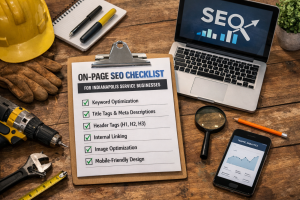
 Indianapolis service businesses don’t just compete on “best plumber” or “roof repair”—they compete on near me intent, trust, and speed. This on-page checklist helps you tighten every page signal (content, structure, UX, and local relevance) so you can earn more calls and quote requests—and make your SEO services Indianapolis investment pay off.
What is an on-page SEO checklist, and why does it matter for Indianapolis service businesses?
An on-page SEO checklist is a repeatable set of page-level tasks that help search engines understand what each page is about—and help visitors take action (call, book, request a quote). For Indianapolis service businesses, on-page SEO is extra important because it supports local intent (“in Broad Ripple”, “near Carmel”, “serving Fishers”) and strengthens your ability to show up in organic results and alongside local map visibility.
How do you set up your page plan before optimizing (keyword mapping + intent + service areas)?
Start by mapping one primary service intent to one primary page. This prevents keyword cannibalization and keeps your site structure easy to crawl and navigate.
Do this first:
- Pick your money pages (core services + core locations you actually serve).
- Assign one primary query theme per page (example: “water heater installation” → one service page).
- Identify the page’s intent: emergency, comparison, pricing, or informational.
- Decide the local coverage: Indianapolis proper + nearby areas (only where you truly serve customers).
What should your title tag, H1, and meta description include to win more clicks?
Google can generate and rewrite title links and snippets, but you can strongly influence them by following best practices.
Title tag (SEO title)
- Put the primary service/topic first, then the brand.
- Make it specific (avoid boilerplate like “Home” or “Service Page”).
- Match what’s actually on the page (misleading titles get rewritten).
H1 (page headline)
- Use one H1 that mirrors the page’s main topic (not necessarily identical to the title).
- Make it human-first: the customer should instantly know they’re in the right place.
Meta description
- Treat it as an ad copy for organic: who it’s for + outcome + proof + CTA.
- Google may rewrite snippets, but quality descriptions help you control messaging when they show.
How do you optimize headings and on-page copy for services without keyword stuffing?
Your job is to make the page scannable and decisive: visitors should understand the service, trust you, and take action quickly.
Heading structure
- H2s = the big decision questions (process, pricing factors, timeline, service area, FAQs).
- H3s = sub-steps or options (types of repairs, materials, packages).
Copy that converts (and ranks)
- Lead with outcomes (“Get same-week repairs…”, “Stop leaks fast…”).
- Add proof: years in business, certifications, reviews, warranties, response time.
- Use location mentions naturally (Indianapolis + nearby areas you serve) only where relevant.
How do you build Indianapolis-ready service pages (location signals + conversion)?
If you serve Indianapolis, your pages should prove it through real content—not just keyword swaps.
Must-have blocks for local service pages
- A clear service promise (who, what, how fast).
- A “Service Areas” section listing Indianapolis + nearby communities you actually cover.
- A “What it costs” section (even ranges and factors help).
- FAQs that match real calls you get from local customers.
- Prominent CTAs (call, form, booking) above the fold and after key sections.
What images, videos, and media optimizations improve speed and visibility?
Media can help conversions (proof photos, team shots, before/after), but it must load fast and be discoverable.
Image SEO best practices
- Use proper HTML image elements and ensure Google can fetch image URLs.
- Compress images and serve modern formats when possible.
- Use descriptive file names (e.g., water-heater-installation-indianapolis.jpg).
- Add helpful alt text (describe the image for users and accessibility; don’t stuff).
How do you optimize internal links and navigation so Google can crawl and customers can convert?
Internal links guide both users and crawlers. Google primarily crawls links when they’re standard anchor elements with an href.
Internal linking essentials
- Link from related blog posts → relevant service pages (and vice versa).
- Use descriptive anchor text (not “click here” everywhere).
- Add “related services” modules on service pages (keeps visitors moving).
- Keep navigation consistent and simple (Services, Service Areas, Reviews, About, Contact).
What technical on-page items should you check (URLs, canonicals, HTTPS, mobile, CWV)?
This is the “don’t lose easy wins” section—small issues can quietly block performance.
URL structure
- Use descriptive, readable URLs and keep structure consistent.
- Avoid messy parameters for core pages when possible.
Canonical tags
- Use rel=”canonical” to consolidate duplicates (especially if you have tracking parameters or near-duplicate location pages).
HTTPS
- HTTPS is a confirmed ranking signal and protects users (also reduces trust friction on lead forms).
Mobile + Page Experience + Core Web Vitals
- Page experience includes mobile friendliness, security, and CWV.
- Use Search Console CWV reporting and performance tooling to monitor LCP/INP/CLS.
How do you add structured data and local trust signals for service businesses?
Structured data helps search engines interpret your content and may enable rich results when eligible—if you follow policy and format guidance.
High-impact schema for service businesses (choose what fits)
- Organization (brand identity, logo, social profiles)
- LocalBusiness (if applicable to your setup)
- Service (for key service pages)
- FAQPage (only when FAQs are visible on the page)
- Review/Rating (only if it meets Google’s eligibility rules—avoid spam)
Trust signals to reinforce
- Real reviews/testimonials (with context)
- Licenses/insurance/certifications
- Clear contact details (consistent across site)
- About/team photos (human proof)
How do you optimize your Google Business Profile to support on-page SEO?
Your GBP helps you compete in local results. Google states local ranking is influenced by relevance, distance, and prominence.
GBP alignment checklist
- Follow Google’s guidelines for representing your business consistently (name, address/service area accuracy, and categories).
- Use the fewest categories needed to describe your core business (and be precise).
- Link GBP to the most relevant landing page (service or location page—not always the homepage).
- Keep hours, services, and contact info accurate across your website and GBP.
What is the printable on-page SEO checklist template?
Use this as a per-page template (service pages, service-area pages, and high-intent blogs).
Page Info (fill this in)
- Page type: Service / Service Area / Blog / Other
- Primary topic (1): __________
- Secondary topics (2–4): __________
- Primary CTA: Call / Form / Booking / Quote
SERP Layer
- Title tag is specific, matches page content, avoids boilerplate
- H1 exists (one), clearly describes the page
- Meta description communicates value + CTA
Content + Structure
- Above-the-fold: clear offer + trust + CTA
- H2s map to buyer questions (pricing, process, timeline, service area, FAQs)
- Proof included (reviews, certifications, warranties, photos)
- Local relevance included naturally (Indianapolis + true service areas)
Media
- Images compressed and relevant
- Alt text describes the image (not stuffed)
Internal Linking
- Links use crawlable anchors (<a href=””>)
- Add 2–5 internal links to/from relevant pages
- Navigation makes it easy to reach Contact/Quote
Technical On-Page
- URL is descriptive and consistent with site structure
- Canonical set correctly (no duplicates competing)
- HTTPS enabled sitewide
- Mobile experience checked (layout, forms, tap targets)
- Core Web Vitals monitored in Search Console
Structured Data + Local
- Appropriate schema added and policy-compliant
- GBP links to the best landing page and follows representation guidelines
FAQ
How many service-area pages should an Indianapolis business create?
Create pages only for areas you genuinely serve and can write uniquely about (jobs, timelines, constraints, testimonials). Thin, duplicated “city pages” can backfire.
Should I put “Indianapolis” on every page?
Use it where it helps clarity (homepage, core service pages, contact/about, service area section). Don’t force it into every paragraph.
Do meta descriptions directly improve rankings?
Meta descriptions are primarily about snippets and click-through messaging—Google may show them or rewrite them depending on the query.
What’s the fastest on-page fix that usually improves leads?
Tightening the hero section: clear offer + proof + CTA above the fold, then reinforcing with FAQs and a second CTA after the process/pricing section.
What should I prioritize if my site is slow?
Start with Core Web Vitals reporting and page experience basics (especially mobile).
Conclusion
On-page SEO is where Indianapolis service businesses turn traffic into revenue: clearer pages, stronger trust, faster load times, and cleaner crawl paths. Use the template above page-by-page, starting with your highest-intent service pages, and you’ll usually see the fastest lift in calls and quote requests. Next, lock in structured data and GBP alignment so your on-page improvements translate into stronger local visibility.
Why QBall Digital Marketing is Your Ideal Choice for SEO services Indianapolis?
QBall Digital Marketing focuses on the on-page work that actually drives service-business leads: the pages people land on, the questions they scan, and the CTAs that move them to call. Instead of generic “SEO fixes,” we build a repeatable optimization system—so every new service page and location page strengthens the whole site.
We also connect on-page SEO to local performance. That means aligning service pages with Google Business Profile intent, tightening technical signals (URLs, canonicals, HTTPS), and improving page experience so users don’t bounce before they convert. The result is a website that doesn’t just rank—it produces measurable inquiries.
Contact QBall Digital Marketing
Ready to turn your service pages into lead-generating assets? QBall Digital Marketing can audit your key pages, apply this checklist across your site, and build a clear roadmap to improve rankings and conversions in Indianapolis. Reach out to get a focused on-page SEO action plan.